Designing for myself: How building a personal training app sharpened my UX thinking
Why creating your own solutions with AI is the ultimate product design workout.
4 min read
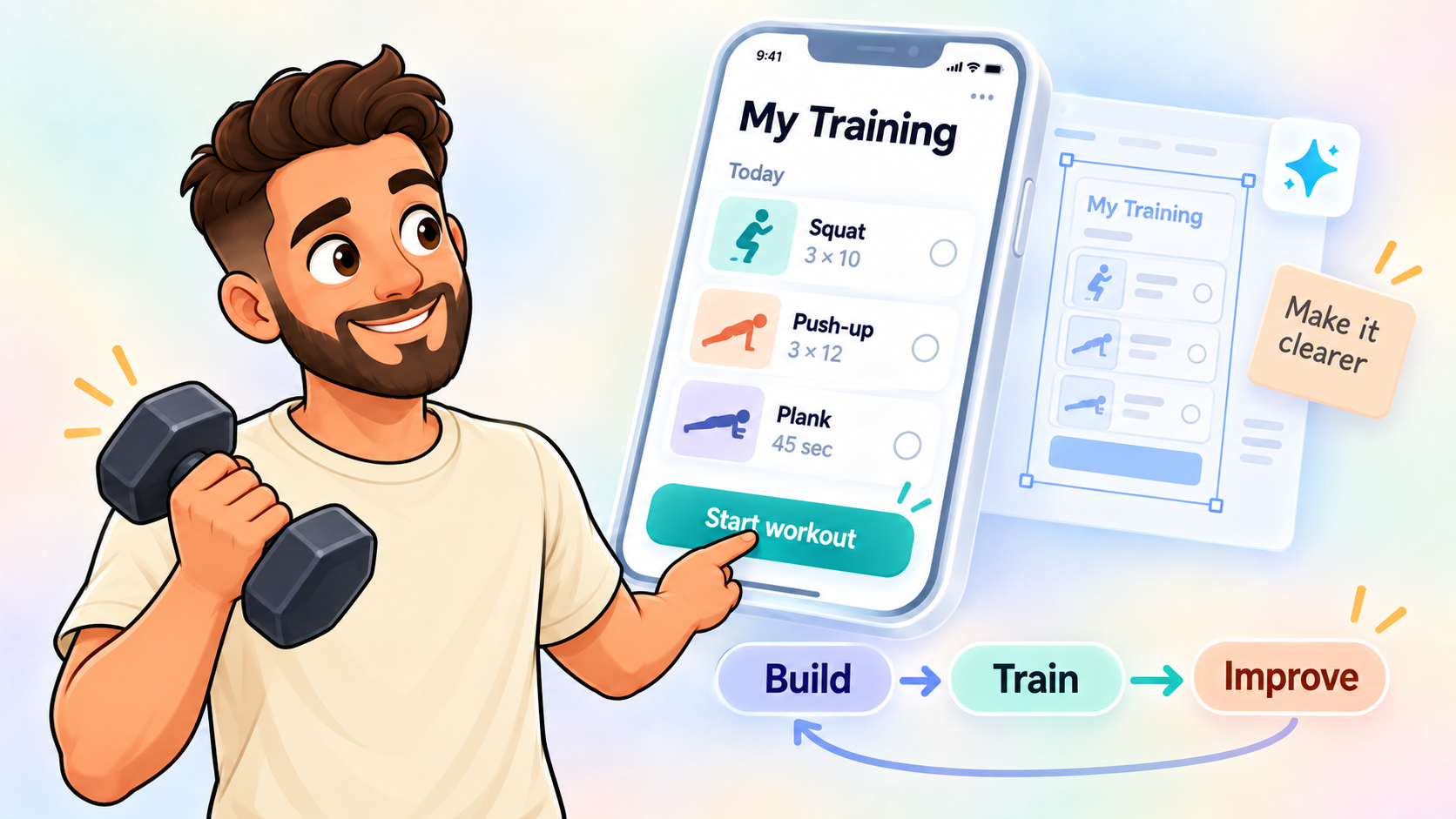
In the early days of generative AI, new tools were appearing almost daily, making it possible to build live experiences from scratch without dramatic effort. As a product professional with a notebook full of ideas, I was eager to dive in and bring them to life. However, I quickly realized that taking an idea to production takes time, so I decided to focus on a more immediate need: my own fitness routine. Designing a solution for myself became the perfect way to test these new tools.
Finding the right problem to solve
I go to the gym about four times a week, and while I enjoy it, my workouts often lacked structure. I found myself favoring machines that were free or exercises I was already comfortable with, which meant I was missing key muscle groups and turning my routine into a mess. The goal became clear. I needed to align my workouts with professional methods, build a reliable bank of exercises, and make them easy to access while on the gym floor. There are countless fitness apps on the market, but none of them fit my specific needs or workout philosophy.
Designing for an audience of one
By building my own app using early AI tools like Lovable, I became both the creator and the sole user. This eliminated the need to search for user feedback because I observed my own pain points during every single session. The feedback loop was instant, allowing me to easily prioritize a massive backlog of features based on what I actually needed for my next workout. When you do not have a lot of free time outside of a full-time job, this clarity makes prioritization incredibly simple.
Being on both sides of the product sharpens your ability to prioritize efficiently and manage side projects smartly.
Features built for real-world context
The app I built was simple, focused, and completely tailored to my approach:
- A clear push and pull routine as the backbone of the plan.
- Specific days for targeted muscle groups, plus scheduled rest days.
- Functionality to adjust reps, weights, and sets on the fly.
- Visual GIFs scraped from the web to help me identify exercises quickly without lingering on the floor.
The ultimate workout for your product mind
In the era of generative AI, the barrier to entry for building functional software has fundamentally shifted. We no longer need large budgets, endless free time, or dedicated engineering teams to bring our ideas to life. We simply need curiosity to start.
Creating this app was not just about fixing my fitness routine; it was about exercising my product muscles. By owning the entire lifecycle — from defining the problem to deploying the solution — I gained a much deeper understanding of system architecture, data integration, and user-centric prioritization. Every bug I fixed and every feature I refined made me a sharper, more empathetic product professional.
I encourage everyone in the industry to take advantage of this shift. Find a small, persistent problem in your daily life, leverage these new AI tools, and start building. It is the most effective way to keep your UX instincts sharp, deepen your technical knowledge, and stay ahead in a rapidly evolving field.
So next time you have some time, think about it: what small, persistent problem in your daily routine will you choose to solve to make your product mind sharper and better?